“The World Was Our Classroom”: An Interview with an Indigenous Educator Winona B.

Interview conducted by Miriam Singer

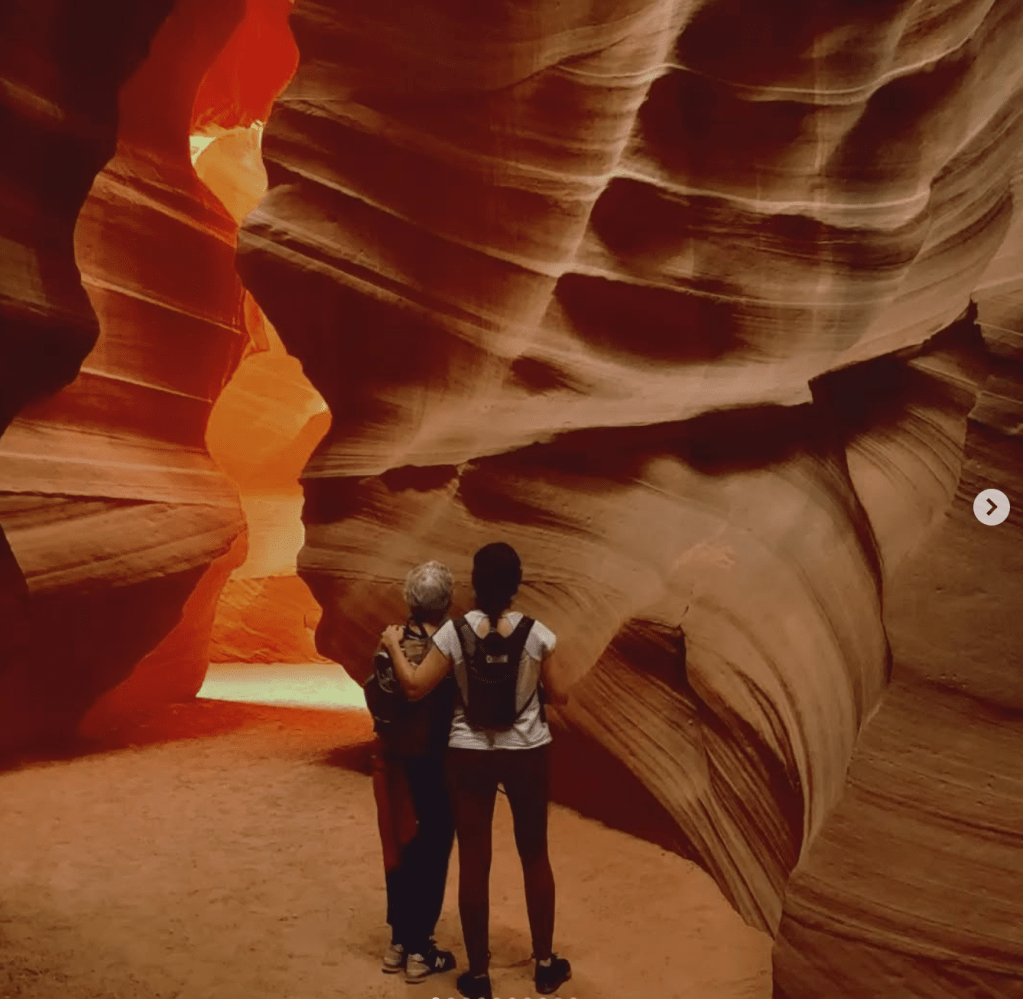
A few summers ago, my mother and I journeyed to Upper Antelope Canyon, a slot canyon located on the land of the Navajo Nation, known for its colorful striations illuminated by beams of light pouring into the tight chasm.  I was looking forward to this adventure experiencing a wonder of the natural world, but what I didn’t expect to happen was to meet a new friend and colleague.  

Since this earthly wonder is on the sacred land of the Navajo, only members of the nation are permitted to lead tourists through their land, so we arranged with a Navajo tour company to meet our guide.  A young woman pulled up to our meeting spot in a white, open-air jeep, greeting us with a hearty Ya at eeh,  which means both hello and it is good in Navajo, introducing herself as Winona. As we bounced over the uneven, desert terrain heading towards the canyon, Winona shared the history of the land of her people.  The Navajo, who call themselves Diné, or “the People,” call Upper Antelope Canyon, Tsé bighánílíní, the place where water flows through, alluding the way the canyon was formed through erosion.  When she shared that during the year she was a teacher, my ears perked up, and I shared that I too am an educator.  As you may already know, it is an unspoken agreement among educators globally that when we meet each other there is an instant bond, and a curiosity to learn from one another.  As interesting as the winding canyon proved to be, my conversations that started that day with Winonabeen even more engaging.

Recently, I was inspired to collect some of the fascinating learnings I have gleaned from Winona about the educational principles that impact the teachings of Diné, when I thought to myself, Why not let Winona share her ideas directly?  When I called her, she was excited to collaborate, and also busy with her summer hustle leading tours.  We agreed that I would record a conversation with her and share the transcript (with a pseudonym as she humbly eschews fame).  The interview that follows reflects an edited version of my recent conversation with Winona.

M: Hi, Winona.  It’s nice to hear your voice- it’s been too long!  Thanks for sharing your knowledge about Navajo teaching practices with the Edcouragementor community. We are excited to learn from you. 

W: Thanks for making the time to chat.  I’m happy to share what I have learned from my elders and community with the larger world of educators.

M: Speaking of what you’ve learned, how did you become a teacher?

W: I grew up here on the land of the Navajo Nation, and what people don’t know is that we are our own sovereign nation within the US, with our own laws and president.  There was very little separation between school and the outside: the world was our classroom, and every Elder was our teacher.  In this way, we grew up to see ourselves as future teachers, and that learning was integrated into everything that we do, whether it was gathering herbs to cure a headache and learning tribal medicine, beading a ceremonial jacket, or listening to a dramatically told story about our ancestors around the fire.  So in some ways, I’ve always seen myself as both a teacher and a student of the world.  Moving to the classroom was a logical step for me in my mind.

M: That sounds like an amazing and aspirational mindset to grow up with.  How does being Navajo impact your teaching?

W: Yes, absolutely, it was a beautiful way to grow up.  And I see how I was raised influences my teaching decisions.  In college, I learned about incorporating voice and choice into lessons to engage students, but that is already a practice I had ingrained in me from my youth.  So much of how we learned from our native teachers asked us to use not just our minds, but our bodies to build, to discover, and to create.  Everything was interconnected and connected to something that mattered in our world.  This made our learning seem useful.  I never forget that when thinking of lesson design for my own students.  The textbook comes last, especially when we have the whole world to learn from.

M: Did you ever have a teacher growing up that didn’t resonate with this ideology?

W: Oh definitely.  I remember in high school we had a non-Navajo math teacher who expected us to drill and kill one algebra problem after the next.  It was connected to absolutely nothing except itself, and was so disengaging, especially compared to the other ways in which we were invited to learn.  We were encouraged to honor our ideas and our own approaches to learning, something that this teacher couldn’t have been farther away from.

M: It sounds like that with time you’ve been able to reflect and discern that his teaching methodologies were not only unengaging, but also very different from the indigenous approach that you were raised with.  Are there other principles that you feel are at the heart of indigenous teaching?

W: I think one thing that is really integral to our ancestral ways is recognizing the privilege we have in learning, that knowledge is a gift, a gift that supports not just one’s self, but also our families, the spirits, the community, our ancestors and the land that we live on.  We don’t take for granted what we can learn from both the land and from others; it’s very relational in that way.  Also, when we look at learning, it’s more than just factual knowledge: it also encompasses that whole being, including the body, soul, and spirit of a human.  We were doing “the whole child” approach thousands of years before it became popular- we were the original native hipsters! (laughs).

M: (laughs) That’s funny, but we should take a moment to recognize that so much of what you’ve been referencing as key to indigenous teaching practices has only  relatively recently become celebrated through progressive education.  With that in mind, what are ways that you would encourage other educators to incorporate indigenous teaching principles into their teaching practice?

W: A few things come to mind.  First, make the learning authentic and connected to the world.  The more your students can learn from the land and natural world, their elders, the ancestral stories (whatever their ancestry might be), and each other, the more impact they will make.  Speaking of stories, stories unlock our imaginations, teach us values for how we can live in harmony with each other and the earth, and are important building blocks of culture.  Never stop telling stories, and invite others in to share their stories too.  And like I said earlier, everything is interconnected; make sure your students see that through how you set up your classroom learning activities.

M: Is there anything else you’d like to share with the Edcouragementor educators?

W:  (laughs) Come visit!  Truly, even if you don’t visit Antelope Canyon, find the local people whose land you live on and try to learn from them.  There is nothing like broadening your world by learning from the people who have been here for a long time.

M: Yes!  I hope everyone will take up your suggestion.  Thanks again for your wisdom.

What stood out to you from what Winona shared, Edcouragementor community?  What other elements of indigenous education have you encouraged in your own learning journey?  Let us know in the comments!

“Science Is Something Anyone Can Do!”

Post By Guest Blogger Kyle Rubalcava

On the first day of school every year, I like to open my classes with a simple question: “What is science to you?” Admittedly, it’s an opportunity for me to get to know the students’ names, but it also presents an opportunity for me to gauge where the students are at in terms of their understanding of and perspective on science. Unsurprisingly with kids, their answers are wide and varied. Boilerplate responses checking off the different fields such as “Chemistry,” “Physics,” and “Biology” crop up frequently, and I would posit such answers are a result of the traditions and thinking of an older generation that defined “Science” as such. Other answers will genuinely astound me; I have had students discuss the composition of matter in detail or note connections between various processes like the water, carbon, and rock cycles.

What the latter answers demonstrate is an emerging grasp of the interconnectivity of scientific understanding. There is an interplay between the various fields of science, such as how chemistry follows the laws of thermodynamics outlined in physics. Science can interact with other fields outside of the traditional STEM umbrella in areas like literature, art, and architecture (hence why I emphasize the importance of adopting a STEAM-based approach to learning). In truth, all of these answers are technically correct but I find them to be a bit strict in their thinking, a sort of “in-the-box” approach to the question.

Ultimately, what I strive to impress on my students is that science is all around us. Science is not bound to a specific field of study, but rather a systematic approach to critical thinking, analysis, and problem-solving. I tell my students that I am no scientist, that I equate that sort of role to someone doing actual research in a lab setting, publishing papers, and engaging with the general rigmarole of academia. What I emphasize is that I am a “sciencer”—a faux word for someone who is innately in love with learning how the world works and operates.

The Next Generation Science Standards seek to impress a similar approach to science. Emphasizing critical thinking, adaptive evidence-based learning, and looking at the crosscutting science can have with other fields, it has truly redefined what science education can be. However, standards are just that—standards. They are guidelines to follow, but it is up to teachers to develop a curriculum to meet those standards, encourage inquiry in their students, and get kids to love science.

In my seemingly brief seven-years-and-counting as an educator, I have developed and taught a variety of different curricula with Chemistry and Earth Science being the more vanilla of the options. Biomimicry was a fun unit exploring how life can relate to and inspire our modern world. However, what I am truly most proud of as an educator was my Physics/Engineering course: Maker’s Space. It fully encapsulated the strengths and framework of the NGSS and truly gave students an inquiry-based approach to learning. While I no longer teach the course as I have since moved on to newer pastures, I still reminisce about the days in those classes.

A unit often began with a central theme, topic, or concept. From there, students would receive an introductory lesson exploring key vocabulary and the theory of the central topic or idea. After that, they were given a challenge to meet and the materials to craft a project that they would then design, build, test, assess, and refine. When the class could meet the requirements of the first challenge, a new one was given to them that built upon their new knowledge. This series of increasing challenges kept students on their toes while adapting to new insights and boundaries.

Key amongst these units was the “Aerodynamics” unit. Students were introduced to the basics of Bernoulli’s Principle (that slower particles pushing on the bottom of a wing create lift) before being tasked to construct three different paper airplanes. While I provided the paper and folding assistance when needed, the students were otherwise on their own to gather designs and build their airplanes. Once the class had a complete set, I had them go outside and throw their planes.

Now, as much fun as chucking a paper airplane may be, it was not for nothing. During these tests, I provided a sheet to my students for them to draw and describe individual plane designs while writing down observations about that specific plane’s flight path and trajectory. I told them to make careful observations about speed, airtime, and any sorts of spins or turns they saw. They would jot down notes, share their feats and glories amongst each other, and we would have a class discussion at the tables outside about their notes. Correlations would be made about how nose/wing shapes affected the speed and path of a plane, but to test those hypotheses, I would invite them into two additional challenges. One was to see whose plane could go the farthest, and another to see whose plane could stay in the air the longest. This required them to reflect on their tests and make a decision based on the data they had gathered. This also invited further discussion amongst them when looking at the general form factor of each plane they chose for each of these new challenges and assessing the winning plane compared to the others in the group.

It is through an activity such as this that the act of making and throwing a paper airplane (something that would have assuredly gotten a kid in trouble in another era) could be turned into a student-led, inquiry-based approach to exploring concepts within aerodynamics. Following our paper airplane activities, we would dive into making foam gliders, which then presented its own set of trials and tribulations. Students had a more rigid material and creativity in wing design to work with, but it also meant there needed to be more precision and intent in their designs. From there, we explored alternative modes of flight with boomerangs and introduced the concept of angular momentum. We explored the similarities of boomerangs to planes and how boomerangs are essentially two wings connected at a single point. As before, students were allowed to build and test their own boomerangs, often to more varied results than the planes.

The unit culminated in an exploration of rockets. On a fundamental level, they follow the same laws of aerodynamics that planes do, but their inherent design acts in a different measure. Whereas a plane’s wings provide lift and keep it in the air, a rocket’s winglets are for stability. Whereas students could throw their planes, we were now launching rockets using the launcher from a “stomp rocket” set. Whereas students could build any shape they wanted in past activities, they had to build around a 500-mL bottle and turn it into an aerodynamic shape.

This is where the students’ creativity in designs truly flourished, and it was always great to see what they could do. Some students elected to use the opening of the bottle as the launching point, adding a pointed cone to the bottom. Others elected to cut off the top quarter of the bottle and attach it to the bottom, creating a pointed nose in the process. One year, I even had a group of students create a rocket that evoked the shape and form of a squid. It, unfortunately, did not fly all that well, but it sure looked good while I was airborne.

Regardless of what they built, students were encouraged in every challenge to gather data, discuss amongst each other, and refine their projects for another test. What they were often engaging in, whether or not they knew it, was the scientific method. The design and scope of the course were never as simple as a standard lab report denoting the various sections of the scientific method. I made every effort to organically weave those components into various aspects of the challenges and projects.

Beyond that, every project was designed to allow students to explore other facets of the science. If a student was still developing their fine motor skills, they could draw up a design for someone else to build. If they had difficulties thinking and working abstractly and designing/building came to them secondarily, I would encourage that they put together the end-of-unit presentation for their group’s final project detailing the more concrete aspects of the creation process. This was in an effort to empower their own individual learning style and help them realize how they might best work within a group setting. This also helped them recognize areas they needed support in and how to develop groups with others based on the strengths they could provide.

Other units in the course included kinematics, fluid dynamics, electricity, and engineering. Each unit followed a similar framework as noted above with accompanying challenges building off of the knowledge and successes of past ones. While my own true passion will always lie within the realm of ecology, Maker’s Space was an encapsulation of what I love about science and what I hope my students will love about it too. It was a course designed to encourage creative thinking, evidence-based decisions, and problem-solving. It emphasized collaboration, communication, and crosscutting amongst the students. While NGSS has been around longer than I have been teaching, I reflect back on my education in the absence of NGSS and wonder if a class like Maker’s Space would have been allowed in an earlier time. How would my view on science be different if my own education emphasized scientific exploration as opposed to rote memorization?

But with where we are now, we have to ask ourselves, “how can we continue to make science fun and engaging for our students? How can we continue to challenge them in new and innovative ways?” Every year, I open up my classes with that same age-old question, “what is science?” One year, I hope to see all of their responses be something akin to “Science is something anyone can do!”

About Our Guest Blogger

Kyle Rubalcava is a proud UCLA graduate and passionate middle school science teacher. Having started his career teaching Chemistry, Physics, and Biology to twice-exceptional students in Studio City, CA, he is now teaching Earth Science at a private school out in Pasadena, CA. In his off time, he enjoys long hikes, longer drives along the coast, and taking photos around Southern California.